
Agent Auto-training
Summary
Auto-training helps you create an agent from project data. It is suitable when you need agent variants without writing instructions from scratch.
Typical scenario
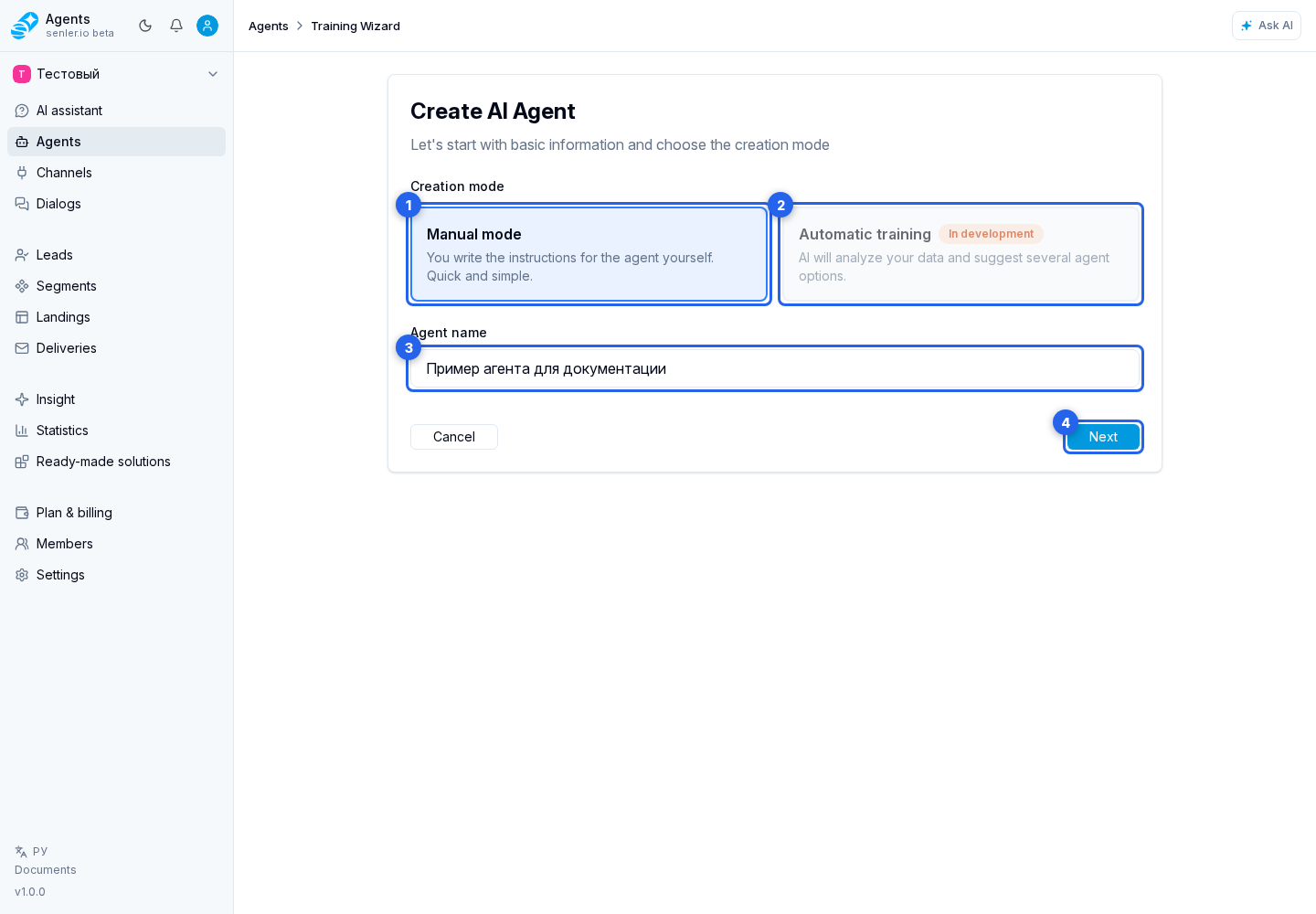
- Choose manual creation or auto-training. For manual creation, enter the agent name and click Next.
- Select data sources. Add an active connected channel to training; paused channels and Email are not shown in this list. When the required supported channel is absent, open Add channel. Continue with Next.
- Configure channel history and choose the training mode. Wait for a current time, volume, and credit estimate, then click Start training.
- The service analyzes the data and shows progress. After completion, review the sources actually used and continue to agent variants.
- AI generates several agent variants and shows planned and actual run costs.
- Choose an agent variant, review its instruction and test, then click Create agent. Change the name if needed and finish with the confirmation button.
Data sources
- VK community;
- additional VK communities;
- documents;
- connected project channels;
- website pages or another source available in the project interface.
Sources can be created, validated, restored after deletion, and selected for training. If a source does not appear during auto-training, check that it exists, passed validation, and is available for training.
For connected channels, auto-training shows whether history is available: old messages are unavailable, history is loading, history has already been saved, only part of the history has been saved, or the previous run ended with an error. If history is supported, it can be used when creating the agent.
Channel history and start estimate
The auto-training setup may show the Load channel history switch. It loads available old messages before generating agent variants. Use the history period field to choose how much history to include.
Nearby it shows:
- how many messages are already in the project database;
- how many messages can be additionally loaded from the platform;
- history period for training;
- details for each selected channel;
- approximate execution time;
- approximate credit cost.
The mode controls processing depth:
- Fast is suitable for a first draft and takes less time;
- Medium balances quality, time, and cost;
- Deep analyzes the data more thoroughly and creates more variants.
A current estimate is required before starting. It is recalculated after sources, history depth, or mode changes. The start button remains unavailable while the estimate is loading or when the AI service cannot return it, preventing a charge without a confirmed limit.
When a free run is available, the cabinet shows its number and how many free runs remain. A paid run shows the approximate charge. Actual cost depends on used AI tokens and does not exceed the confirmed estimate.
The switch is unavailable while the estimate is being calculated, when no channels are selected, when history loading is unavailable, or when the selected channels have no additional messages to load. If a specific reason is known, it appears directly below the switch.
Supported Documents
- TXT;
- PDF;
- DOC;
- DOCX;
- CSV;
- JSON;
- MD.
What does AI do when learning
- loads sources;
- analyzes content, style and themes;
- selects the optimal type of agent and metrics;
- generates agent options;
- shows the user options to choose from.
After an option is selected, auto-training adds all available metrics to the created agent: built-in metrics for the selected agent type and the project's custom metrics. Event and discussion sets are saved separately in manual mode, so later changes to default sets do not silently replace the selection.
After creation, open metric settings and remove indicators that this agent does not need. Each group can be switched back to default metrics independently. If automatic metric selection fails, the agent is still created: configure events and discussions manually in its form.
During training
- the process may take time;
- the page can be closed, training continues in the background;
- the state can be tracked by stages: parsing, AI analysis, generation of options, completion;
- if history loading is enabled, auto-training first retrieves available channel messages and then generates agent variants;
- for a website, auto-training may first build a page plan, then select important pages or continue with regular site discovery;
- the current URL, number of processed items, and selected pages may be shown in progress;
- training can be stopped with Stop; after stopping, scanning and generation end, and the return to settings button lets you start training again;
- when progress appears delayed, refresh the state; after an error, copy support information.
After completion, the page does not immediately hide the result. The Data used section shows actually processed sources, saved website pages, and their usefulness when these details are available. Then select Go to variant selection.
The variant step shows planned and actual time, planned cost, actual AI cost, and the final charge. Some values may remain Settling while the calculation finishes.
Retraining
For an existing agent, the wizard loads the previous run's sources, mode, and history depth. Change at least one setting and select Save and retrain. When the actual previous configuration cannot be loaded, the cabinet shows a warning instead of inventing replacement values. Retraining does not start when nothing changed.
Statuses and stopping
- "In progress" - the task is running;
- "Queued" - the task is waiting to start;
- "Errors" - part of processing failed;
- "Stopped" - the user cancelled active tasks;
- "Training stopped" means the current run will not produce agent variants until the user starts training again.
If no options appear
- check the status of the process;
- check if there is enough data;
- check for errors in the process or history;
- if the error is related to channel history loading, try reducing the period or turning off old history loading;
- if the status is "Stopped", return to settings and start training again;
- try another source or create an agent manually.
Starting and monitoring training
- agent settings form
- agent list
- Agents item in the side menu