
AI-Sensey
What it is
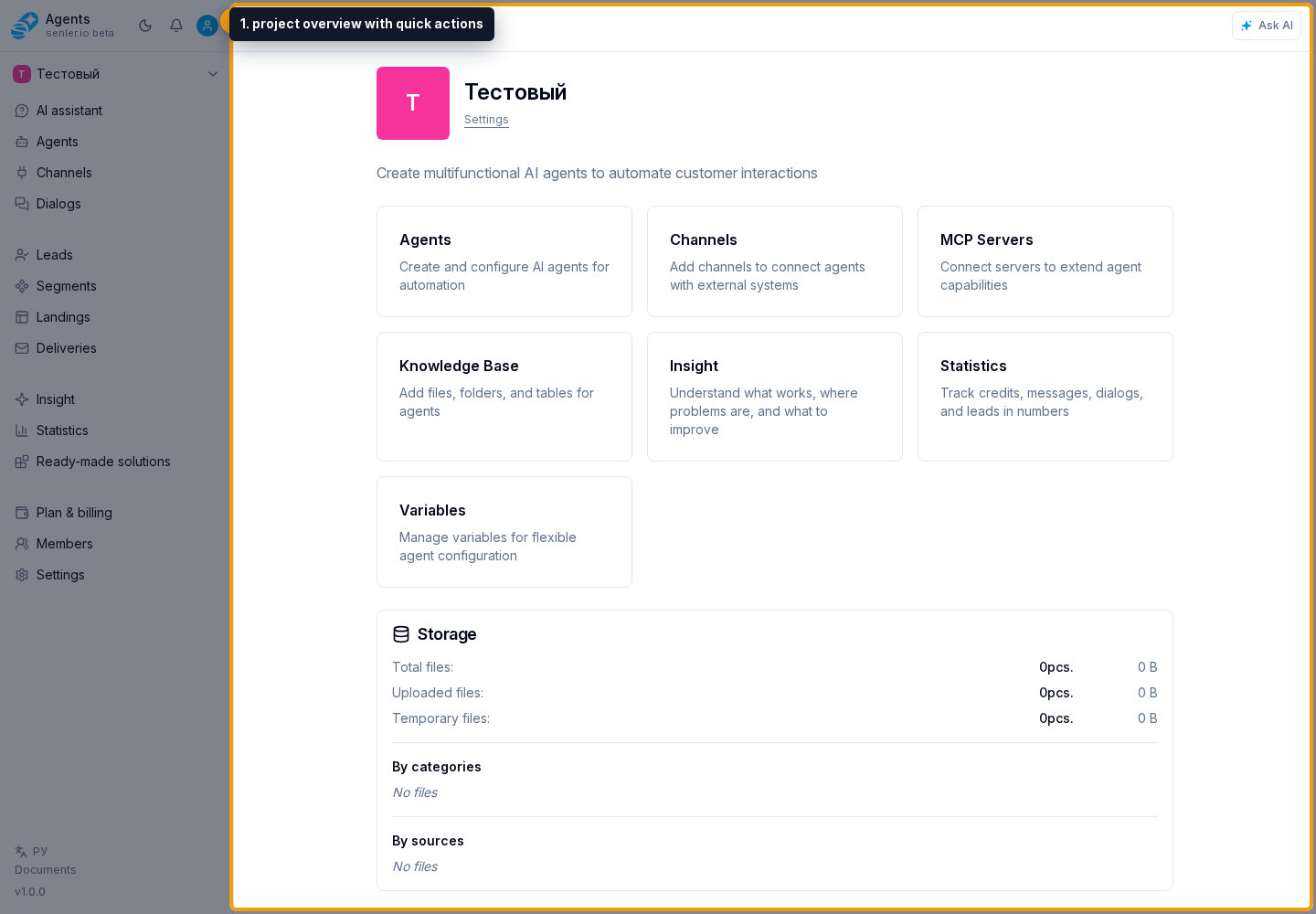
The AI-Sensey item in the side menu opens a full-page chat inside the current project. This is the assistant's primary page, not a project overview with section cards.
The assistant automatically accounts for the current project and open section. When a specific entity is open, that entity is also included, such as an agent, channel, automation, segment, landing, or MCP server. In dialogs, the assistant also receives the selected dialog and its channel.
How to ask a question
Describe the result. When the required entity is already open, you normally do not need to repeat its name: it appears above the message field. If you only want advice, say so explicitly: “Tell me where this setting is changed. Do not press or change anything.” For a question about a particular place on the page, select that element before sending the message.
You can ask the assistant about saved conversations. Open the dialog you need and ask, for example: “What was the customer interested in?” or “Why didn't the agent add this customer to the Egypt segment?” After reviewing the conversation, you can move on to an action: “Add this customer to the ‘Family holidays’ segment.”
To look into several conversations, specify which ones interest you, such as inquiries about family holidays from the past week. A large selection is easier to review in smaller groups. For an overview of a week or month, visit Insight.
The numbers in the screenshot identify:
- The history button.
- attachments.
- element selection on the open page.
- emoji.
- A voice message.
- The send button.
When you select an element, the cabinet enters pointer mode and intercepts the click on the chosen field, button, or block. The element is attached to the question as context, but the click does not perform its normal action or change anything. Press Esc to cancel selection.
Question context
Context chips appear above the message field. The project and current section are added automatically; the open entity and its name appear where they help distinguish the object from the section. For example, an automation page shows both the Automation section and the selected automation, while dialogs show the channel and selected participant. A manually selected element appears as a separate chip.
You can open a chip to verify the context or remove it before sending the message. When you move to another entity, automatic context is refreshed so the assistant does not keep treating the previous entity as open.
The Discuss change button in an AI summary starts a new conversation, attaches the project, agent, issues, and suggestions from the selected recommendation, and then automatically sends a prepared question. Opening this conversation does not change the agent by itself.
Answers and actions
If widget actions are enabled for the assistant agent, it can send one of the supported commands to the open page: highlight an element, scroll to it, focus it, click it, fill or clear a field, select a list option, or toggle a control. If the element is hidden and the interface links it to a revealing element, the cabinet runs the reveal action first. For step-by-step highlighting, the assistant may first show the element that you need to open manually.
The assistant must not send such a command without an explicit request to perform an action. If the command appears in a new response, the cabinet runs it automatically and does not add a general confirmation screen. The cabinet blocks filling fields for passwords, card numbers, CVC/CVV codes, and card expiration dates.
The command result appears in the chat:
- a successful status means the browser ran the command, but not necessarily that the whole operation is complete—for example, a click may only have opened a confirmation form;
- Not found means that no matching element could be found on the open page;
- Blocked means that the element is ambiguous, hidden, disabled, does not support the command, or is a protected field;
- an error means that the page did not run the command or did not return a result.
After a command, check both the result card and the interface. Not found, Blocked, or an error does not confirm a change.
Conversation history
The history button opens the conversation list. You can create a new conversation, find a previous one through search, or open the chat you need.
A new conversation is useful for a separate task when the previous context is no longer relevant. Moving between sections of the current project does not delete the open conversation.
Working over other pages
On other pages, the Ask AI button opens the same assistant over the current section. On a wide screen, the display settings let you choose a side panel or a floating window. On a narrow screen, the assistant occupies the available area.
The selected mode is saved in the current browser. When you move to another section, the assistant updates its automatic chips and keeps the open conversation. A manually selected element is not replaced automatically: remove it or select an element on the new screen.
Ask AI hints
On a computer, the cabinet can show an Ask AI offer after you hover over a marked element; on a touch screen, it can appear after a long press. The offer opens a new conversation and attaches the project, page, and selected element. You then write the question yourself.
To turn these offers on or off:
- Select the assistant button.
- Open the settings menu.
- Switch element hints.
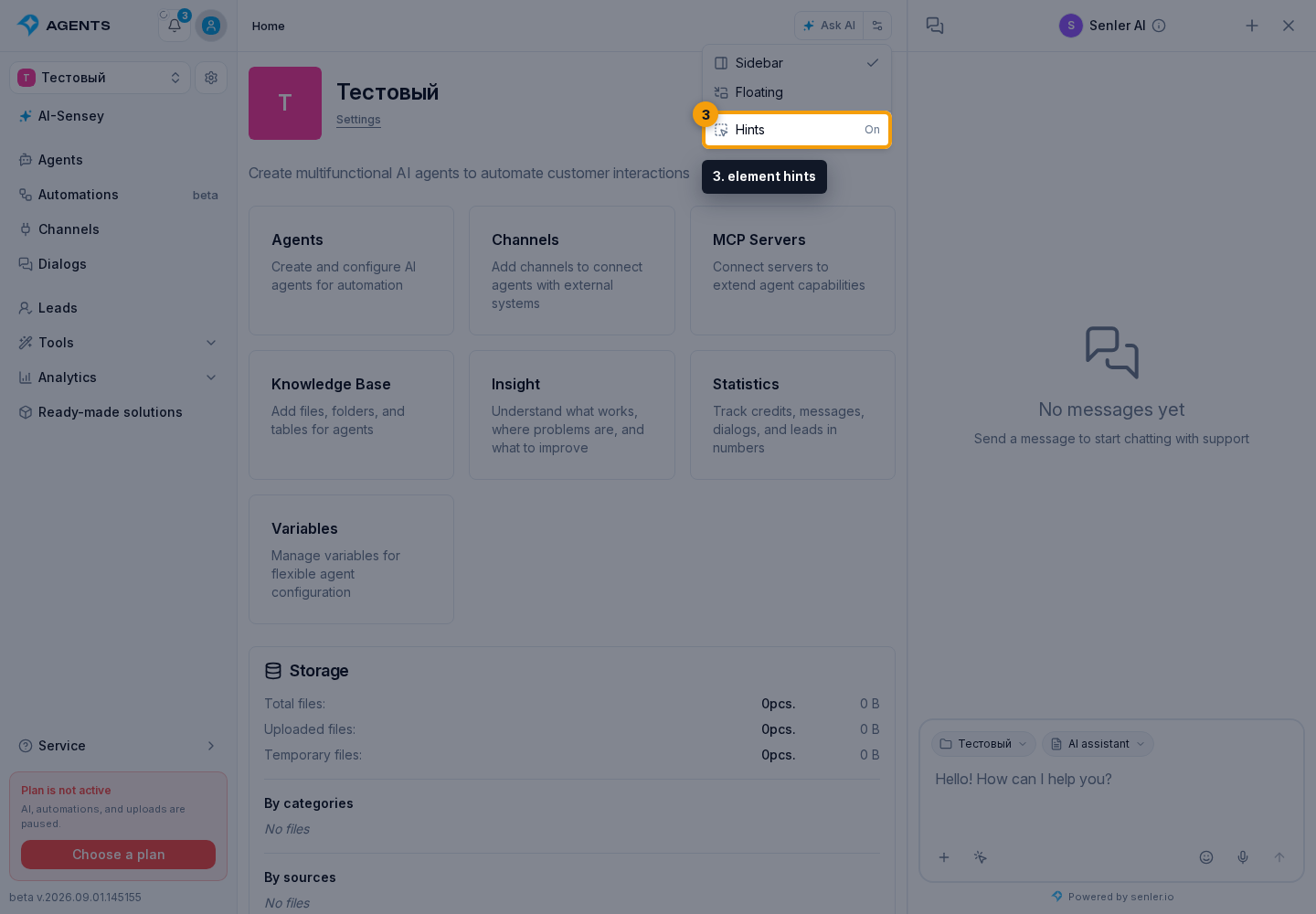
Turning this option off removes only the offer next to elements. You can still open the assistant manually and use the element selection button in the message field. The preference is saved in the current browser and is also passed to the dialogs screen.
Navigation from an answer
An assistant response can show a button that opens the relevant place in the cabinet. Supported destinations include a specific dialog, the dialog list, the lead list, and one lead profile. When the assistant creates or finds an entity, it can also offer to open an agent's Testing tab, a particular landing's settings, or a particular automation editor. The transition runs only after you select the button in the response; message text alone does not change the page. Multiple dialogs use one transition to a filtered list.
If an analytics selection is included in the transition, the dialog list shows the AI summary selection chip. This is a filter passed in the link. Remove the chip to clear it and return to the full list.