
Insight AI Summary
Summary
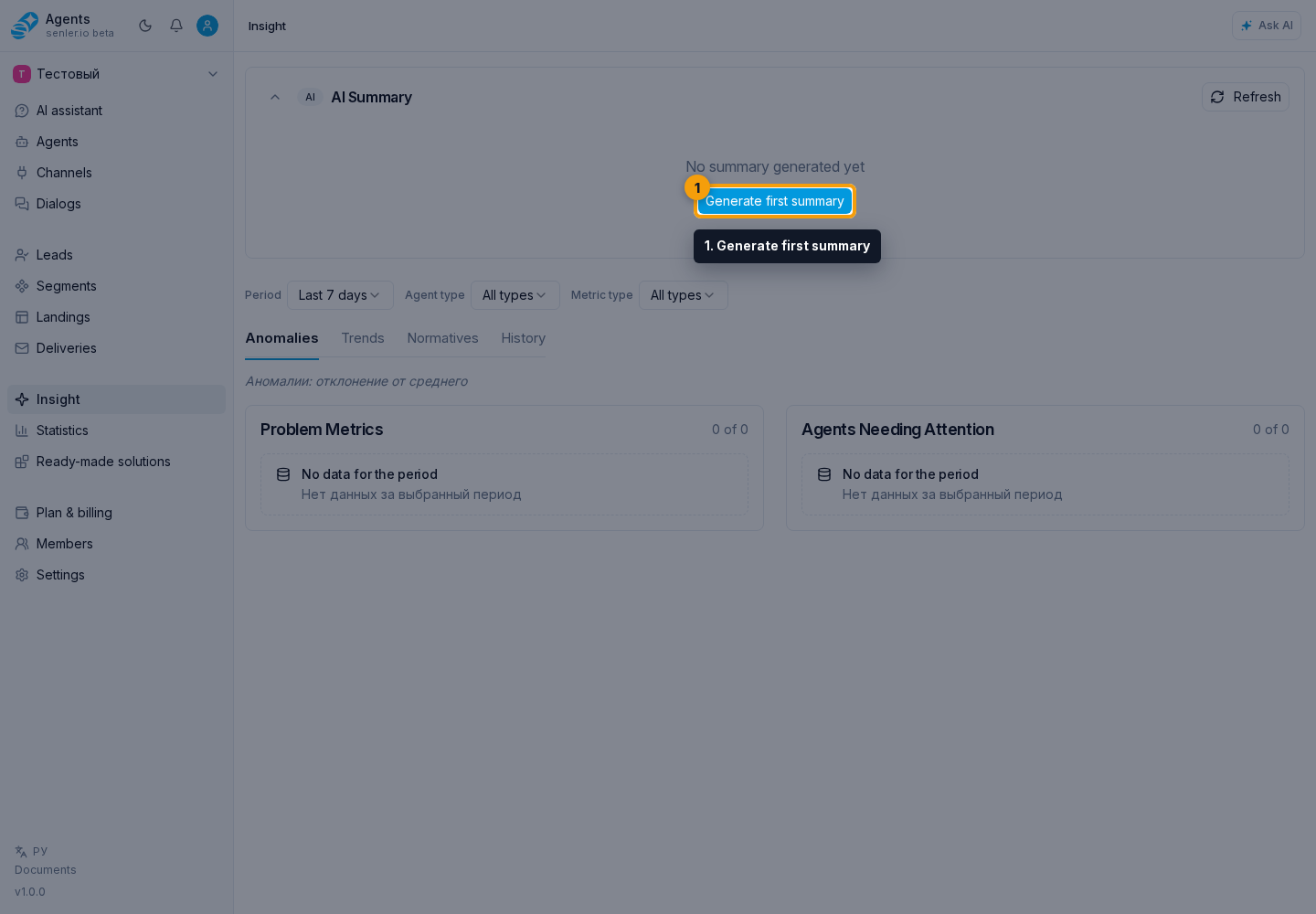
Open Insight in the side menu. The section page contains the AI summary.
The AI summary helps you understand customer conversations during the selected period: what customers ask about most often, what difficulties arise, and how agents could improve.
A practical way to read a completed summary is to start with the overview for a quick sense of the situation, then verify the highlighted positive aspects and problem areas against metrics and conversations. If the selected period contains enough data, review the important discussions. Treat the recommendations as starting points for decisions: some concern agent configuration and performance, while others concern the business as a whole.
How to verify a summary conclusion
Choose the appropriate way to check it:
- Anomalies show whether an agent or metric really stands out from the rest;
- Trends help verify a change compared with the previous period;
- Normatives show the difference from a target value;
- History lets you find the individual results that formed a metric.
For example, the summary may show that customers often ask about family holidays but do not receive a suitable offer. Click Open dialogs next to the topic to take a closer look at those conversations. You can discuss an individual conversation with AI-Sensey: “Why didn't the customer choose a tour, and what should the agent have offered?”
Important discussions
The Important discussions section groups recurring topics in the selected period. Each discussion can include:
- title and high, medium, or low priority;
- unique dialog count and the topic's share of dialogs in the selected period;
- state: Ongoing, Completed, Mixed states, or State unknown;
- trend within the period: New topic, More conversations, No notable change, or Fewer conversations;
- last-seen date;
- short explanation;
- possible customer or business impact;
- recommended actions.
The percentage shows the topic's scale among dialogs available for analysis in the selected period that contain lead messages, not its share within the short topic list on screen. It is an analytical estimate: one dialog can contain several meaningful segments and one segment can contain several topics, so the same conversation may support different topics and their percentages do not have to add up to 100%. Grouping quality depends on available dialog content and the agent's configured discussion categories.
Click Open dialogs to go to the saved selection of conversations that support the topic. The list shows the AI summary selection chip: while it is active, only supporting dialogs are shown. Click the chip with the close icon to remove the selection and return to the full list.
The number on the button shows the topic's total scale. For a very large topic, the saved review selection may contain fewer dialogs than that number. The button is unavailable when the discussion has no accessible dialogs. If an old selection no longer opens, refresh the AI summary and open it again. Check specific messages and factual metrics before acting; use equal durations and refresh the summary separately when comparing periods.
Automation recommendations
The Automations requiring attention section checks published automations against metric observations accumulated during the selected period. A conclusion for one metric and workflow area requires at least three observations.
Each recommendation shows the automation, priority, detected issues, and suggested changes. Select Open workflow to go to the editor. If the recommendation refers to a specific step, the editor selects it and moves the workflow into view.
When there are no recommendations, the section explains the check result:
- no issues were found, together with the number of checked observations;
- published automations do not have data yet;
- data exists, but no metric and workflow area has reached three observations;
- the project has no published automations;
- automation data was temporarily unavailable, while the rest of the summary was generated normally;
- the summary predates automation analysis and must be refreshed.
No recommendations does not by itself indicate an error. Compare the conclusion with automation runs and factual metrics before changing a workflow.
Discussing a recommendation
An agent recommendation has an agent, priority, issue list, and suggestions. The cabinet may show the agent avatar next to the recommendation so it is easier to see who it belongs to.
The Discuss change button opens the cabinet assistant and attaches the project, selected agent, issues, and suggestions from the recommendation to a new dialog. The user does not need to copy text manually: the dialog opens with the needed context. Clicking the button does not change the agent; a change is possible only after a separate explicit request and user confirmation. If the project has not loaded yet, the button is unavailable.
The answer is based on the specific agent and the specific recommendation the user opened. The user does not need to explain again which summary they mean.
Generating and refreshing
If no summary exists yet, use Generate first summary. For an existing summary, click Refresh. In both cases:
- a model selector opens, with the current model marked separately;
- after opening the field, you can find a model by its display or system name using search and choose a suitable option;
- for the selected model, the cabinet shows estimated credit consumption with a margin for possible additional analysis stages, the project balance, and a warning when the balance is insufficient.
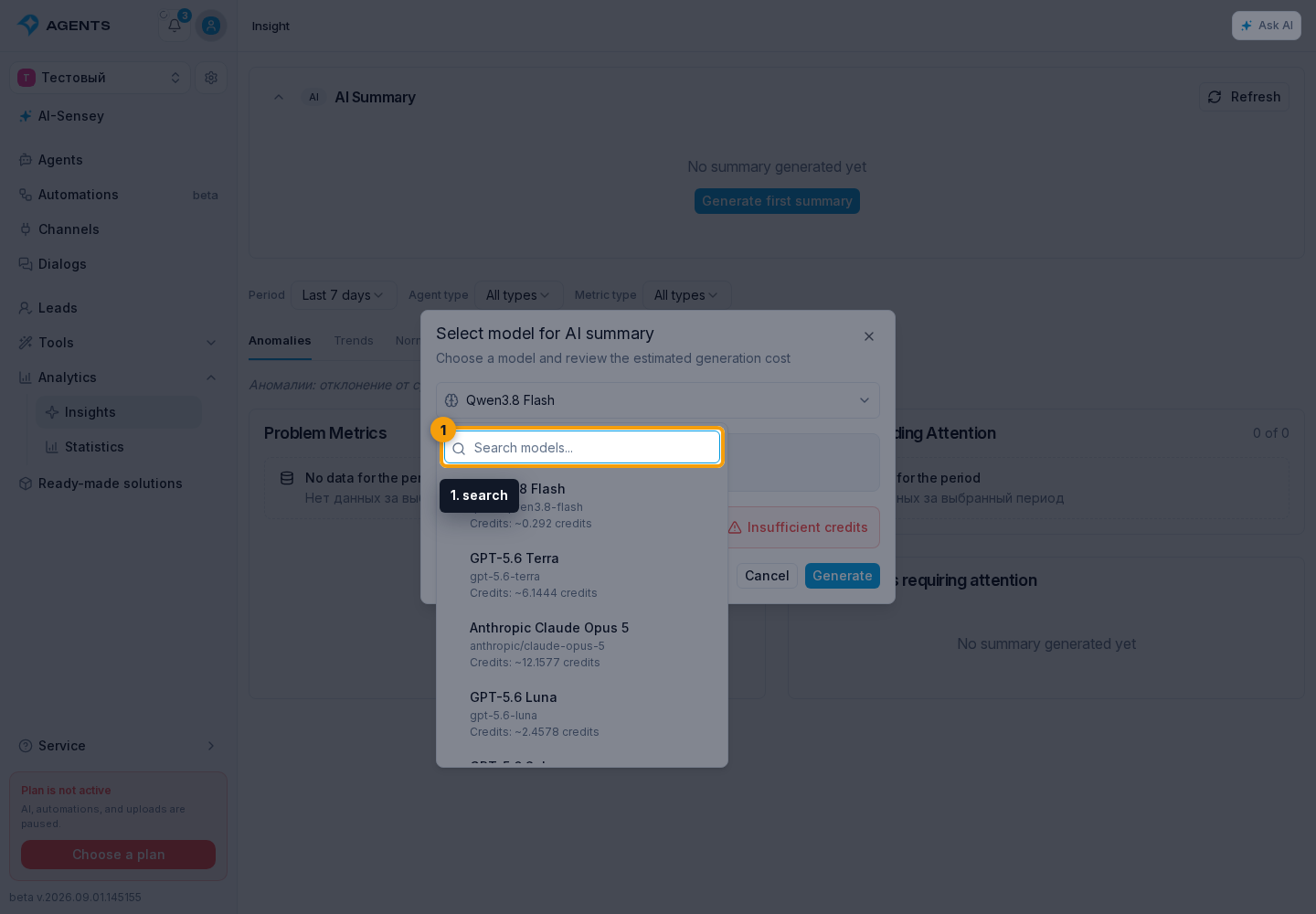
The estimate helps select a model and check the balance, but it is not the final debit amount. After generation, the footer shows the actual consumption next to the preliminary estimate.
Use the header button to collapse or expand the summary. Collapsing it does not delete the result.
Generation details
- model;
- tokens;
- expected and actual credit consumption;
- generation time;
- generation date.
If you need to understand why the summary is not being generated
- check the balance;
- check the selected period;
- check the presence of dialogs and metrics;
- check the model;
- check generation errors.